

If your air conditioner keeps turning on and off every few minutes without ever fully cooling your home, you’re dealing with a frustrating — and potentially expensive — problem called short cycling. The good news? In many cases, the fix is simpler than you think. Here’s what’s causing it and exactly what to do about it.
What Is Short Cycling?
Your AC is designed to run in steady cooling cycles, typically 15 to 20 minutes at a time. When it kicks on and off repeatedly in short bursts — sometimes as little as every 2 to 5 minutes — that’s short cycling.
It’s not just annoying. Short cycling:
- Wears out your compressor faster — the most expensive part of your system
- Drives up your energy bill — startup draws more power than steady running
- Fails to dehumidify your home — the system needs full cycles to pull moisture from the air
- Creates uneven temperatures — some rooms never fully cool down
The Most Common Cause: A Dirty Air Filter
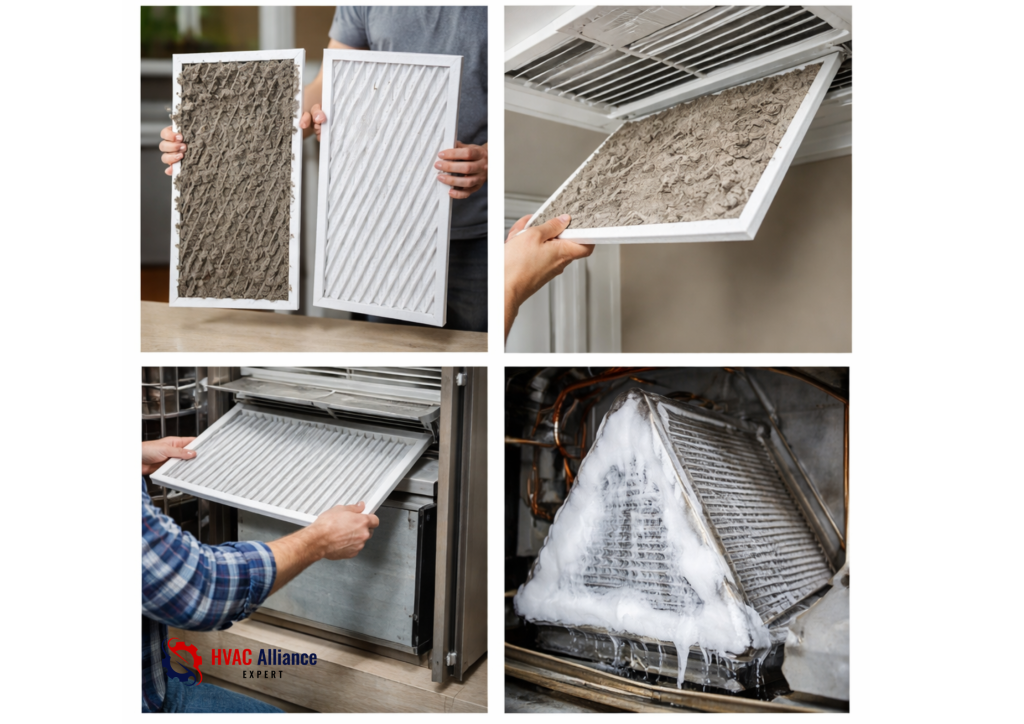
Before calling a technician, check your air filter. A clogged filter is the single most common cause of AC short cycling — and it takes less than five minutes to fix.
Here’s what happens: when your filter is clogged with dust and debris, airflow through the system is restricted. The evaporator coil gets too cold and eventually freezes over. Your AC senses the problem and shuts itself off to prevent damage. A few minutes later, it tries again — and the cycle repeats.
The fix:
- Turn off your AC at the thermostat
- Locate your air filter — usually in the return air vent or inside the air handler
- Pull it out and hold it up to the light — if you can’t see light through it, it needs replacing
- Replace with the correct size filter (check the frame for dimensions)
- Turn your system back on and monitor for normal cycling
If your system was running with a clogged filter for a while, the evaporator coil may have frozen. In that case, turn the system to fan only for an hour to let it thaw before resuming normal cooling.
Other Common Causes of Short Cycling
1. Low Refrigerant
When refrigerant levels drop due to a leak, your system loses its ability to absorb heat properly. The pressure drops, the system overheats or over-cools, and it shuts off early. Low refrigerant doesn’t fix itself — it always means there’s a leak somewhere that needs to be found and repaired.
Fix: Call a licensed HVAC technician. Handling refrigerant requires certification and specialized equipment.
2. Oversized AC Unit
If your AC is too large for your home, it cools the space too quickly without running a full cycle. It hits the thermostat’s target temperature in minutes, shuts off, and then the temperature rises again just as fast. This is called “oversizing” and unfortunately, it can only be fully resolved by replacing the unit with a properly sized one.
Fix: Have an HVAC professional perform a Manual J load calculation to determine the correct unit size for your home.
3. Thermostat Issues
A faulty or poorly placed thermostat can cause short cycling. If it’s positioned near a heat source — like a sunny window, a lamp, or an air vent — it reads the temperature incorrectly and signals the AC to shut off too soon.
Fix: Check the thermostat location and make sure it’s on an interior wall away from direct sunlight and heat sources. If the unit is old or malfunctioning, replacing it is an affordable fix that can make a big difference.
.
4. Frozen Evaporator Coil
Beyond a dirty filter, coils can also freeze due to low refrigerant or restricted airflow from blocked vents. A frozen coil forces the system to shut down to protect itself.
Fix: Turn the system off, let it thaw completely (this can take a few hours), then identify what caused the freeze. If it happens again after a filter change, call a technician.
5. Electrical or Compressor Issues
If your compressor is overheating or your system has an electrical fault, it will shut itself off as a safety measure. This is the most serious cause of short cycling and requires immediate professional attention.
Fix: Stop running the unit and call an HVAC technician. Running a struggling compressor repeatedly can destroy it entirely.
Replacing a furnace blower capacitor is one of the more manageable HVAC repairs a homeowner can take on. The part typically costs between $10 and $50 depending on the rating and type — a fraction of what a service call costs.
When purchasing a replacement:
- Match the exact µF rating printed on the old capacitor
- Match the voltage rating — never go lower, though slightly higher is acceptable
- Purchase the same type — start, run, or dual-run
To install, simply reverse the removal process: mount the new capacitor in the bracket, reconnect the wires exactly as they were in your photo, replace the access panel, and restore power at the breaker.
If the blower still won’t start after replacing the capacitor, the issue may be with the blower motor itself — which is a more involved repair best handled by a licensed HVAC technician.
How to Tell If It's Getting Worse
Watch for these signs that short cycling is escalating into a bigger problem:
- The AC runs for less than 2 minutes before shutting off
- You hear clicking, buzzing, or grinding sounds at startup
- Your energy bill spikes suddenly with no change in usage
- Ice forms on the refrigerant lines or outdoor unit
- The air coming from vents isn’t cold even briefly
Any of these symptoms mean it’s time to stop running the system and call a professional.
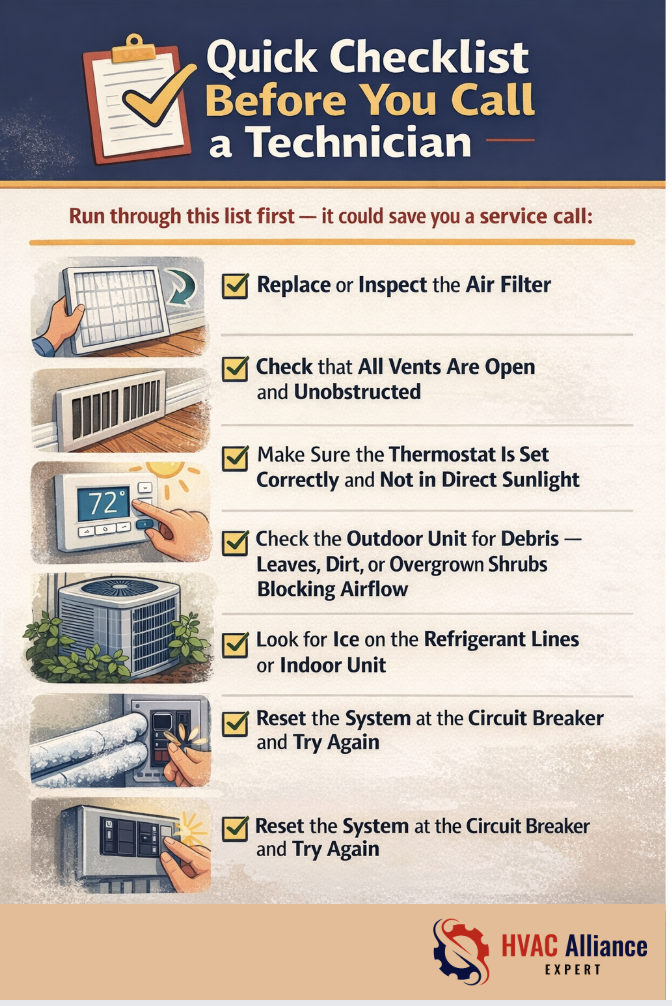
Quick Checklist Before You Call a Technician
Run through this list first — it could save you a service call:
- Replace or inspect the air filter
- Check that all vents are open and unobstructed
- Make sure the thermostat is set correctly and not in direct sunlight
- Check the outdoor unit for debris — leaves, dirt, or overgrown shrubs blocking airflow
- Look for ice on the refrigerant lines or indoor unit
- Reset the system at the circuit breaker and try again
When to Call an HVAC Professional
If you’ve worked through the checklist and the short cycling continues, it’s time to bring in a pro. You should also call immediately if:
- You suspect a refrigerant leak
- The compressor is making unusual noises
- Ice has formed on any part of the system
- The system is more than 10 years old and showing multiple symptoms
Short cycling puts enormous stress on your AC system. The longer it goes unaddressed, the more likely you are to face a costly compressor replacement — or a full system breakdown in the middle of summer.
Conclusion
Short cycling is one of those problems that seems minor until it isn’t. Start with the simple fix — a fresh air filter — and work through the checklist before assuming the worst. But if the problem persists, don’t keep running your system hoping it resolves itself. A quick service call now is almost always cheaper than a compressor replacement later.
Think your AC might be short cycling? Our HVAC technicians can diagnose the problem fast and get your system running efficiently again. Contact us today to schedule a service call.
FAQs
Short cycling is when your air conditioner turns on and off repeatedly in short bursts — usually every 2 to 5 minutes — instead of running full cooling cycles of 15 to 20 minutes. It’s a sign something is wrong with your system and should be addressed promptly.
A dirty or clogged air filter is the number one cause. When airflow is restricted, the evaporator coil freezes and forces the system to shut off. Replacing your filter is the first thing to check before calling a technician.
Yes, significantly. Every time your system starts up, it puts heavy strain on the compressor — the most expensive component in your AC. Repeated short cycling accelerates wear, shortens the lifespan of your unit, and increases the risk of a full system breakdown.
If your AC kicks on and off every few minutes without ever fully cooling your home, that’s short cycling. Other signs include uneven temperatures throughout the house, higher than normal energy bills, and ice forming on the refrigerant lines or outdoor unit.
You can handle basic checks — replacing the air filter, clearing debris from the outdoor unit, making sure vents are open, and checking your thermostat placement. However, causes like low refrigerant, electrical faults, or compressor issues require a licensed HVAC technician.